Recurly
Most subscription trackers are a list of prices. Recurly is a list of reasons: it records why you subscribed and shows it back to you before each renewal, so you decide with the facts in front of you.
- Status
- Open source, v0.1.0
- Stack
- React, TypeScript, Vite, FastAPI, SQLAlchemy, SQLite
- Runs
- On your own machine, no Docker
- License
- MIT
The problem
Subscriptions are easy to start and easy to forget. A tracker that lists names and prices tells you what you pay, but not why you started, whether you still use it, or what quietly depends on it.
By the next renewal, the reason you subscribed is easy to have forgotten, and the choice that remains is between a price and a shrug.
The idea
Don't just track what you pay. Remember why you pay for it.
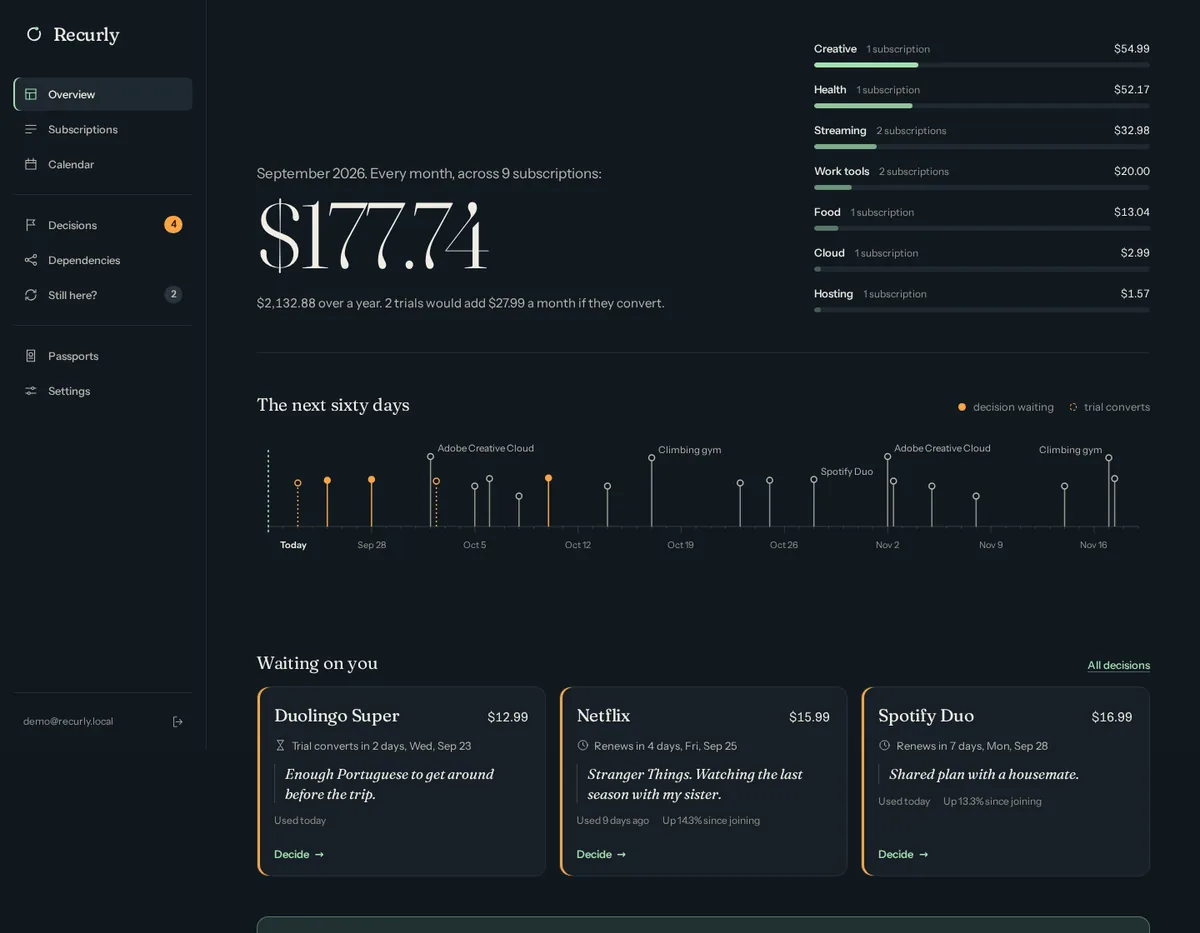
Most subscription trackers are a list of prices. Recurly is a list of reasons. When you subscribe, you write down what it was for. When the renewal comes round, Recurly shows you that sentence next to what actually happened since: whether you used it, what the price did, what leans on it. Then you decide.
It runs on your own machine, keeps everything in one SQLite file and makes no outside requests.
A quick tour
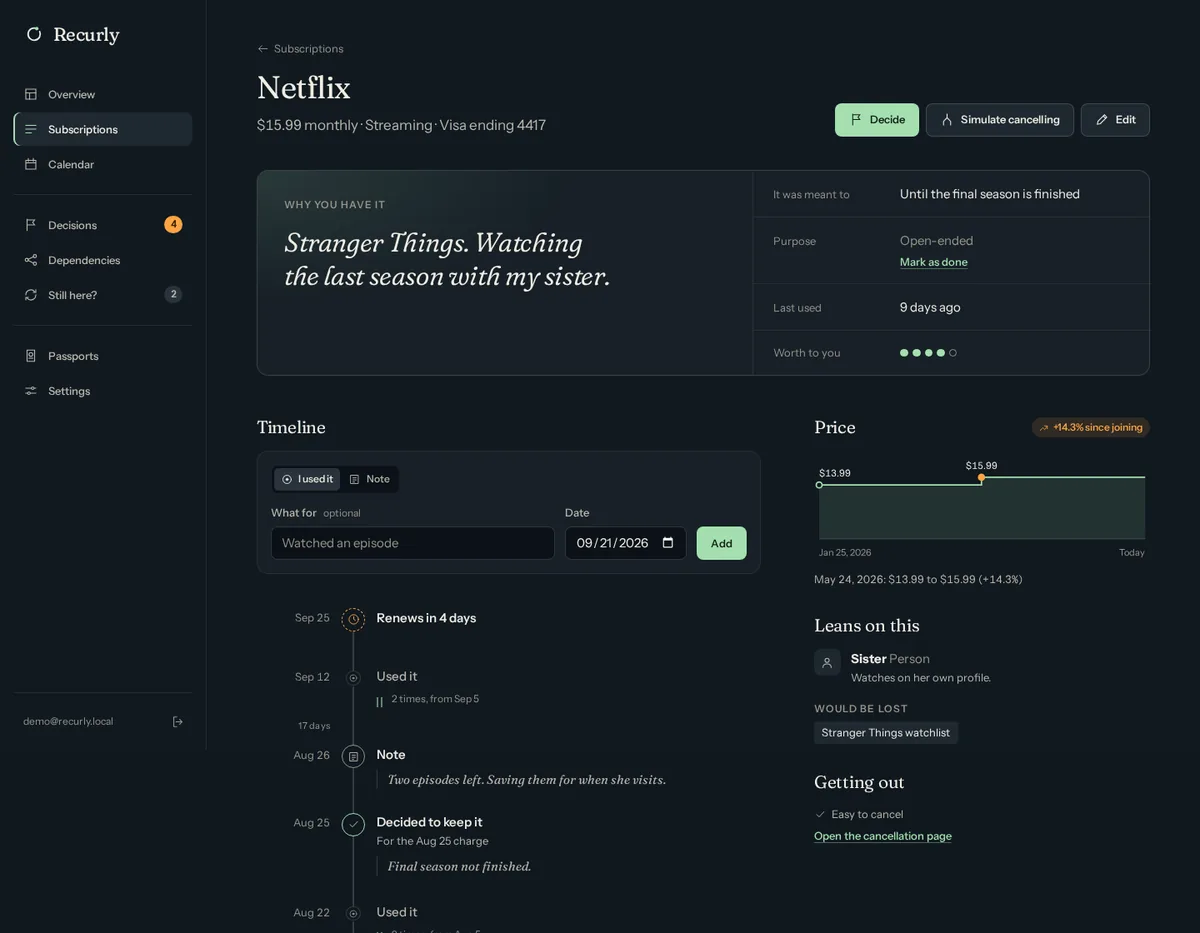
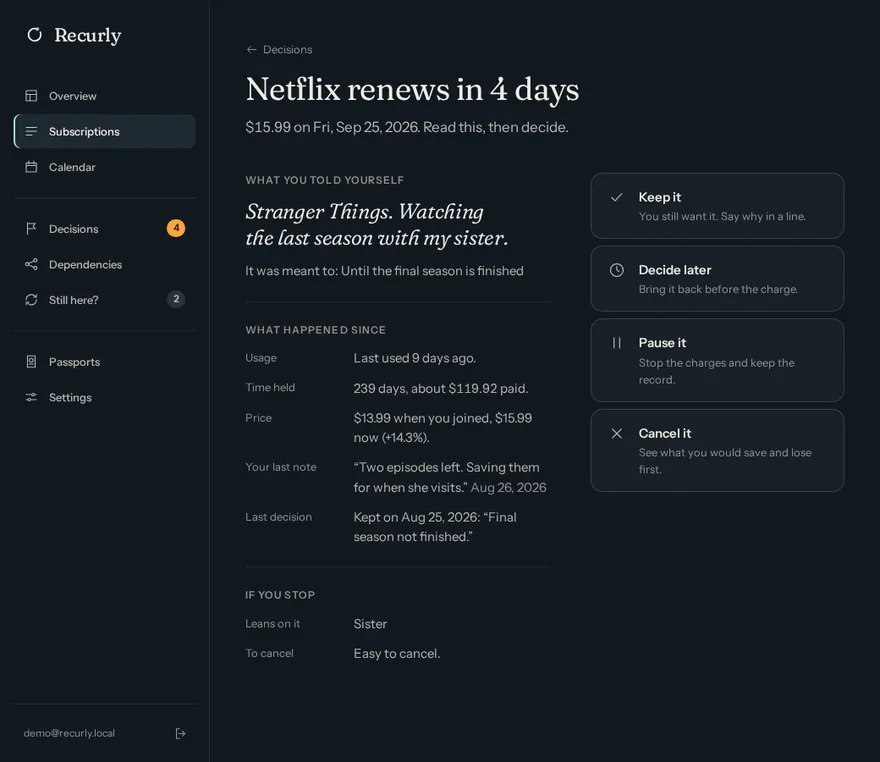
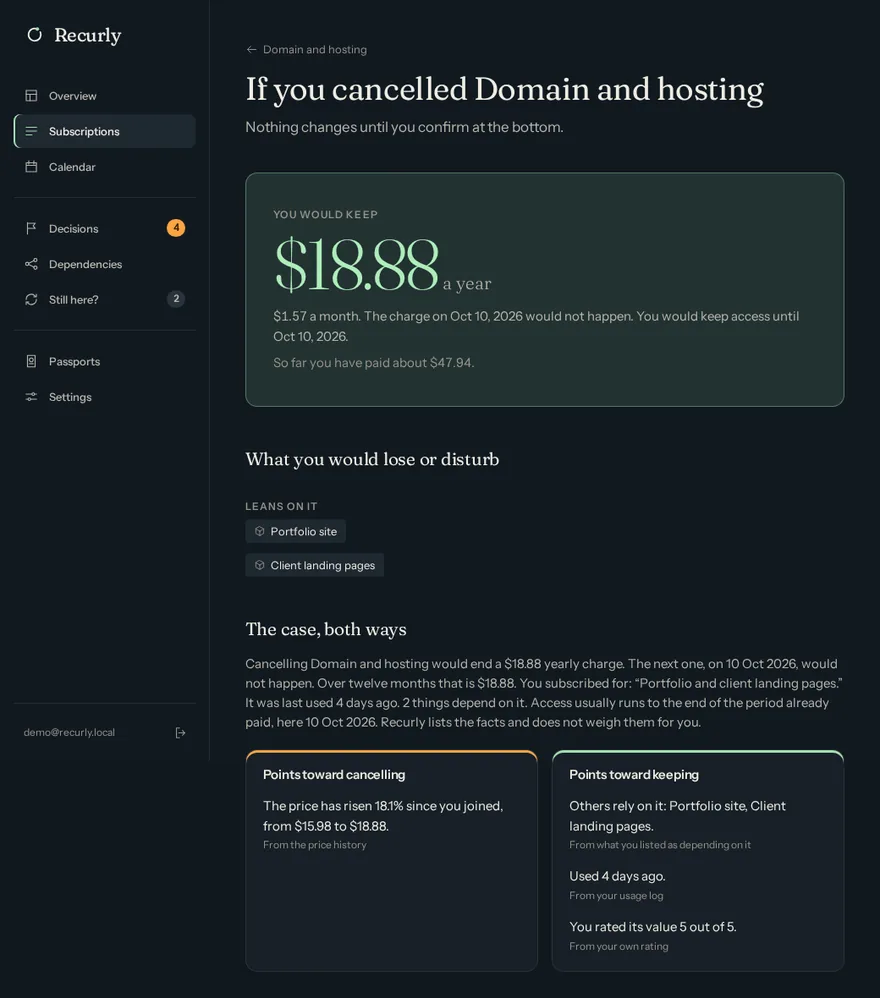
These screenshots use the seeded demo data that ships with the project.
What it offers
- A record of why
- Each subscription has a Black Box: why you took it, what it was meant to achieve, whether that is done, what depends on it, how hard it is to cancel, and a timeline of everything that has happened to it.
- A decision before each charge
- A few days ahead of a renewal Recurly opens a decision showing your own words, your usage and the price history, and asks: keep, pause, cancel or decide later. Your answer and your reason go on the timeline and come back at the next renewal.
- Simulate cancelling
- See what you would keep per year, what would be lost or disturbed, and the facts that point each way. It lists facts and does not score them. A checklist covers the people, files and content that depend on it.
- "Why do you still have this?"
- If a subscription's purpose looks finished and you have stopped using it, it appears in a short review.
- A dependency map
- A page that maps what you recorded as depending on each subscription.
- Passports
- Every subscription exports as a plain JSON file with everything you recorded. Import them back on this instance or another.
- Optional statement import
- Upload a bank statement CSV once to find repeating charges. It is read in memory and not kept.
How it decides when to speak up
There are no scores, no machine learning and no recommendations. Where Recurly has an opinion, it is one of a handful of plain rules, and the screen says which one. These are the defaults, and the first four are adjustable in Settings.
| Rule | Default |
|---|---|
| A renewal decision opens | 7 days before |
| A trial decision opens | 3 days before it converts |
| Yearly-ish plans (six months or longer) open early | at least 21 days before |
| Counts as unused after | 45 days without a logged use |
| A review is offered every | 30 days |
| Quiet after "keep" in a review | 90 days |
| A price rise worth listing | 10% or more since joining |
A subscription is only offered for review when its purpose looks complete, meaning the intended end date has passed or you marked the outcome as done, and it has gone quiet. With no end date there is no evidence the purpose is over, so an old subscription is never treated as stale just for being old.
A small thing that took care: billing dates
Charge dates are counted from the first charge, never by adding a month to the previous one. Otherwise a plan anchored on the 31st drifts to the 28th after February and stays there. Pick an anchor day and compare:
Monthly plan, first charge in Jan 2027Illustration| Charge | Adding to the last date | Counted from the anchor |
|---|---|---|
| 1 | 31 Jan 2027 | 31 Jan 2027 |
Highlighted dates are where the two methods disagree.
Passports: a format, not just an export
A passport is one subscription and everything recorded about it, as a single JSON object. The format is documented, has a JSON Schema, and the schema is generated from the code. CI fails if the two drift apart, so the documentation cannot quietly go stale. Here is a trimmed example:
{
  "passport_version": 1,
  "name": "Netflix",
  "price": 15.99,
  "currency": "USD",
  "billing_cycle": "monthly",
  "purpose": "Stranger Things. Watching the last season with my sister.",
  "intended_outcome": "Until the final season is finished",
  "dependencies": [{ "kind": "person", "label": "Sister" }],
  "decision_history": [
    { "date": "2026-08-25", "decision": "keep", "reason": "Final season not finished." }
  ]
}
Decisions and challenges
- A pure decision engine
- The engine is a set of pure functions. They take a plain snapshot of a subscription plus today's date and return what to show, and they never touch the database or the clock. That is what makes every rule testable and keeps the rules readable. A rule that cannot be described in a sentence or two is probably too clever.
- Facts, not a verdict
- Simulate cancelling lists what points toward cancelling and what points toward keeping, each line naming the fact it came from. Neither list is added up, and Recurly does not tell you which side wins.
- The server enforces the checklist
- Marking a subscription cancelled requires every checklist item to be acknowledged, and the server refuses the request, with the missing items, if one is not. The rule does not live only in the interface.
- Privacy by construction
- No analytics or telemetry. Fonts ship inside the app, and the content security policy forbids outside requests. Passwords are hashed with scrypt, sessions use HttpOnly cookies and sign-in is rate limited.
- Self-hosting without Docker
- It is one process. The repository includes a hardened systemd unit, Caddy and nginx examples for HTTPS, and a backup script that makes a consistent copy of the database while the server is running.
Status and links
Recurly is open source under the MIT license and at v0.1.0. It is deliberately upfront about what it does not do:
- No reminders by email or push. Decisions appear in the app.
- No bank connection and no live exchange rates, because both would mean outside requests.
- No passkeys yet. Sign-in is email and password.
- Postgres is accepted but untested, and there are no database migrations yet.
- It cannot cancel anything for you. It records the decision and reminds you what to do.
Try the live demo, or run it on your own machine (Python 3.11+ and Node 20+):
git clone https://github.com/LwkMoon/Recurly && cd Recurly
python3 -m venv .venv && . .venv/bin/activate
pip install -e "server[dev]"
(cd web && npm ci && npm run build)
cd server && python -m recurly      # http://127.0.0.1:8000

# optional: look around with sample data first
python -m recurly.seed